Testing are subjected to sustained compressive or tensile stress over a long period—such as plastic pipes, chemical storage tanks, automotive structural components, or electrical cable insulation—a specific phenomenon often occurs. Creep Or, gradual deformation over time, which can lead to a loss of shape or structural failure during long-term actual use.
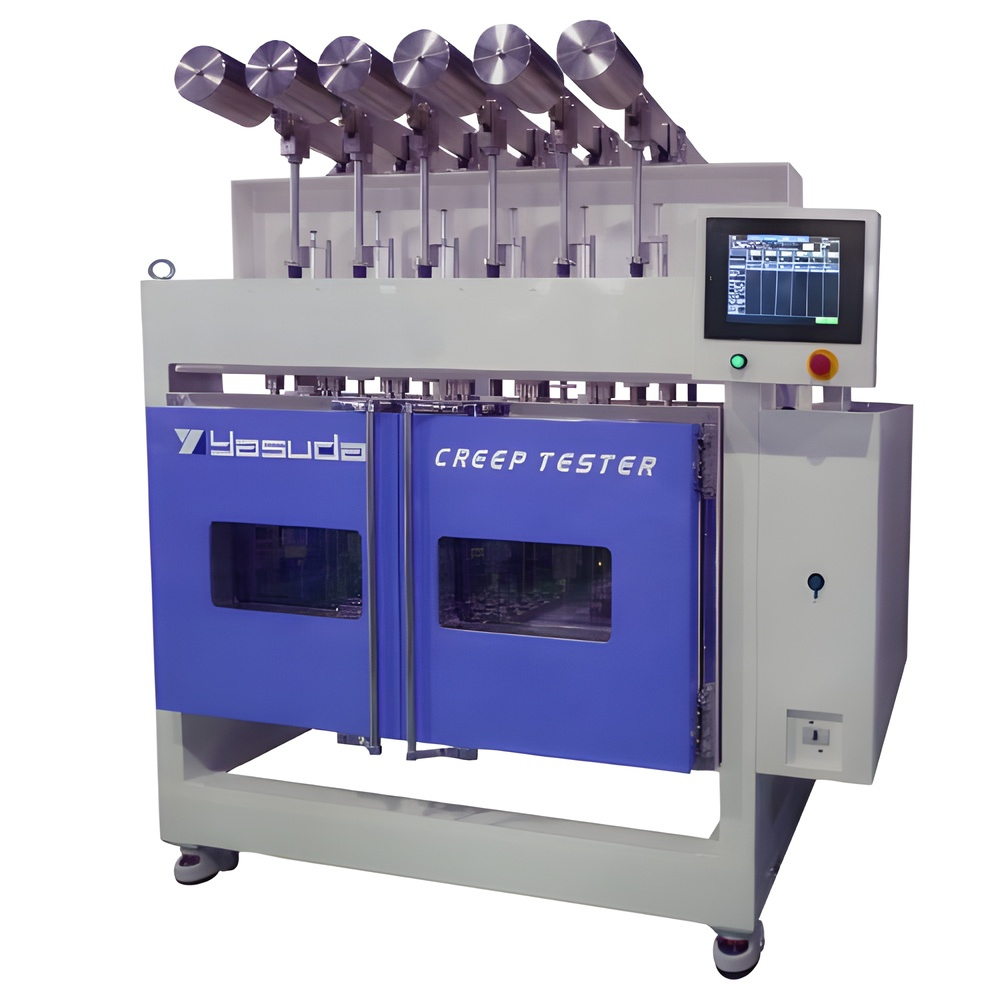
Creep tester No. 145-B From Yasuda Seiki, using a high-resolution distance sensor.(0.01 mm)combined with a stable heating system
Analysis of creep over a long test duration: Measure and analyze creep deflection under constant tensile, compressive, or bending loads throughout the test duration.
Measure deformation with a precision of 0.01 mm: A magnetostrictive transducer is employed to continuously and consistently record the expansion or contraction of the workpiece.
Supports simultaneous testing of up to 10 specimens: Available in Pulley, Balance Scale, and Servomotor system versions, depending on the type of load being used.
Capable of simulating high-heat conditions and environmental settings: Reaches a maximum temperature 200 ℃ (Adjustable up to 300 ℃ ) Optional low humidity and temperature control cabinet available.
JIS K7115、ASTM D2990、ISO 899-1
| Specification | Model No.145-BCREEP TESTER (BALANCE TYPE) |
|---|---|
| Hangings | 3, 6, or 10 Hangings (3 kinds) |
| Specimen | See JIS K7162 for reference |
| Load Method | Balance Scale Type |
| Weight Load | Max. 5 kN (500 kgf) |
| Displacement Measurement | Magnetic Linear Scale 1/100 mm, Stroke 0 to Max. ± 40 mm |
| Temperature Range | Max. 200 °C |
| Software | Windows Compatible |
| Option | Compression Jig, Bending Jig, Low Temperature Oven, Constant Temperature & Humidity Oven, Divided Oven, Gauge Length Measuring Spec |
| Power Source | Differ by Specifications. |
| Dimensions / Weight (Approx.) | Differ by Specifications. |
Q: What is the significance of the creep phenomenon (creep test) in the testing of plastics and rubber?
A: Creep testing allows engineers and R&D teams to determine the extent to which a material will stretch or deform when subjected to a constant load over an extended period (such as months or years). This helps prevent issues like component deformation or a loss of load-bearing capacity during actual use.
Q: What is the difference between model No.145-A/B and model No.145-SV?
A: Models No.145-A and B utilize a mechanical counterweight system—employing either a pulley or a balance scale—to provide stable and straightforward application of pressure or tension. In contrast, model No.145-SV incorporates a servomotor combined with a load cell, enabling precise control over applied force, minimizing impact shock at the moment of specimen rupture, and offering the added capability of performing stress relaxation tests within a single unit.
Q: Is it possible to conduct tests under cold conditions or with controlled humidity?
A: Yes, that is possible. The unit offers an optional environmental chamber—available as either a low-temperature chamber or a temperature and humidity-controlled chamber—to accurately simulate real-world environmental conditions.

 Contact Us
Learn More About Us