A Guide to Selecting a Melt Flow Tester (MFI / MVR) for Plastics Manufacturing and the Polymer Industry (in accordance with ASTM D1238 / ISO 1133 standards)
July 21st, 2026
A Melt Flow Indexer is a laboratory instrument used to measure the flow rate of molten plastic pellets (in units of g/10 min) under specified standard temperature and weight conditions. ASTM D1238 And ISO 1133 To control the quality of raw materials before they enter the plastic injection molding or extrusion process.
Why is the selection of an MFI tester important for plastic QC and R&D departments?
In the manufacturing of plastics and polymers, the MFI (or MVR – Melt Volume Rate) serves as a "health indicator" for plastic pellets. If the MFI value deviates from the specified range, it can lead to issues during the injection molding process—such as parts becoming overly brittle, the appearance of sink marks, or even clogging of the machinery. Therefore, selecting a testing instrument that meets international standards is crucial for significantly reducing potential losses in the production line.
The key factors that buyers should consider are not limited to just “price”; they also include Accuracy, Worker safety And Reduce human error: There are 4 key factors that need to be checked, as follows:
4 Key Factors for Selecting a Melt Flow Indexer
Compliance with International Standards: The equipment must meet the key standards currently in use at the factory, such as: ISO 1133-1, ASTM D1238 And JIS K 7210 To ensure that test results are accepted by clients and partners worldwide.
Capability to perform both Procedure A and Procedure B tests:
Procedure A (Mass Method): Measured by cutting off samples of the molten plastic at specific intervals and weighing them; suitable for basic applications.
Procedure B (Displacement Method / MVR): Measures piston displacement using a sensor; suitable for automated applications or tasks requiring MVR (Melt Volume-flow Rate) values.
Accuracy and Piston Height Measurement System: An error of even a few millimeters when cutting a specimen or measuring distance will immediately lead to an inaccurate MFI value. A high-quality instrument should feature a precise displacement measurement system to minimize human error.
Safety and ease of use: เนื่องจากต้องทำงานที่อุณหภูมิสูง (สูงสุดถึง 300–400 °C) ระบบตัดชิ้นงานอัตโนมัติและหน้าจอควบคุมที่ชัดเจนจะช่วยลดความเสี่ยงจากแผลพุพองและทำให้การเทรนนิ่งพนักงานใหม่เป็นเรื่องง่าย
Comparing Popular Series: Why Is the Leading Japanese Brand, Yasuda Seiki, the Top Choice for Japanese Factories in Thailand?
For factories that demand high precision and premium-grade durability, testing equipment from the Japanese brand Yasuda Seiki Distributed and serviced by Smart Phat Global Highly trusted, due to:
The machine structure is built from durable materials, ensuring a long service life of 10–20 years.
The weight-loading mechanism and die-and-piston assembly fully comply with both JIS and ASTM standards.
Data analysis software, which connects to a computer, enables the storage of test reports for immediate data archiving.
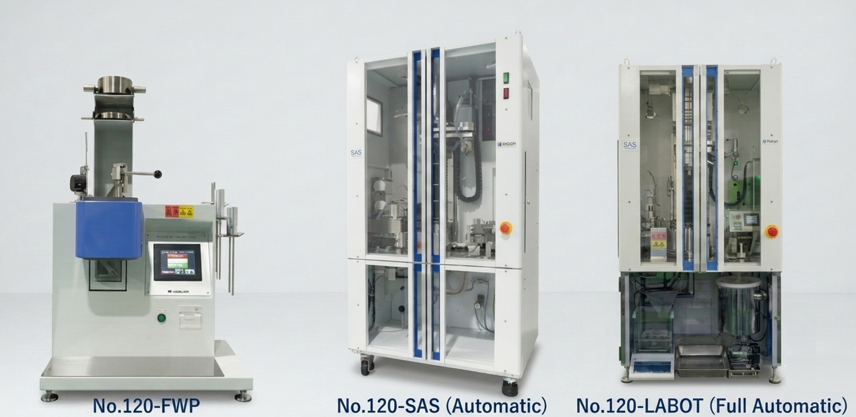
Comparison table of the three main models of Melt Flow Indexer (120 Series) from Yasuda Seiki This is to help customers clearly see the differences in terms of functionality, level of automation, and suitability for specific use cases.
Comparison Table of Functions and Specifications for the Yasuda Seiki 120 Series
No.120-FWP :For small- to medium-sized laboratories, R&D facilities, or factories with a low daily volume of tests—ideal for those seeking a cost-effective solution without compromising on Japanese-standard precision.
No.120-SAS:Laboratories with a moderate volume of testing seek to reduce the burden on staff—such as loading samples, adjusting weights, and performing cleaning tasks—in order to minimize human error and enhance safety.
No.120-LABOT:Large-scale petrochemical plants—or major QC laboratories that must process samples 24 hours a day (with the capacity to run up to 50 samples continuously)—seek to reduce manual labor while ensuring the highest level of accuracy.
Interested in a high-quality melt flow tester for your business?
FAQ: Frequently Asked Questions About Purchasing an MFI Machine
Q: How often should an MFI instrument be calibrated?
A: It is recommended to perform calibration at least once a year, or in line with the factory’s ISO audit cycle, by a certified service provider.
Q: Can the same MFI testing machine used for virgin plastic pellets also be used for recycled plastic blends?
A: That is feasible; however, recycled plastic typically exhibits a broad molecular weight distribution. Therefore, it is advisable to choose a system with built-in statistical averaging functions for greater convenience and efficiency.


 Contact Us
Learn More About Us