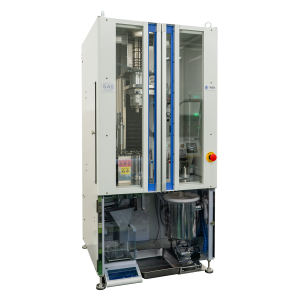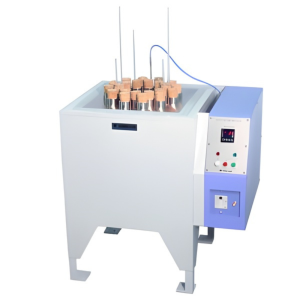
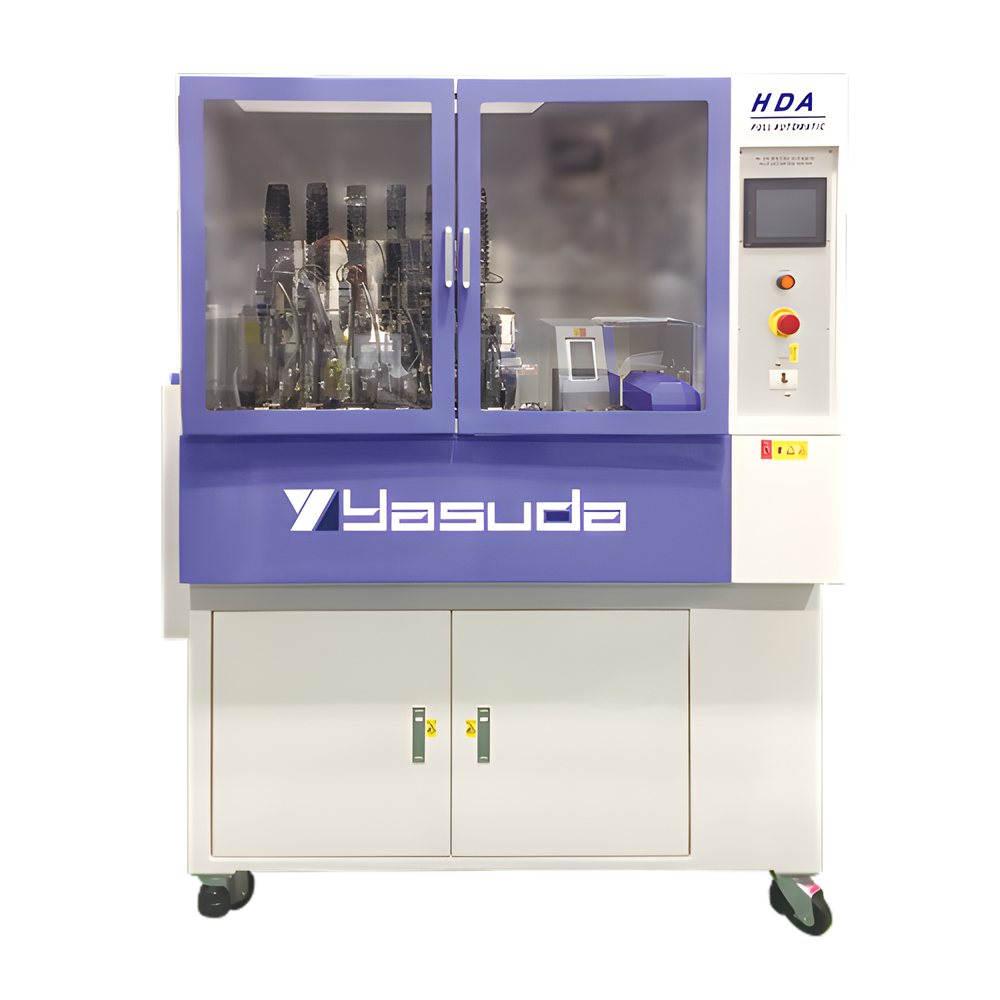
The No.148-HDA Automatic HDT/Vicat Tester from Yasuda Seiki is a fully automated system designed to analyze the heat resistance properties of plastics and polymers. It measures the Deflection Temperature Under Load (DTUL) and the Vicat Softening Temperature (VST) in compliance with international standards, including ASTM D648, ASTM D1525, ISO 75, ISO 306, and JIS K7191. This instrument is ideal for quality control (QC) laboratories and research and development (R&D) centers within the plastic resin and automotive components industries that require high precision and the capacity for high-volume, continuous testing. Simply place the specimens into the specimen feeder, and the computer software will direct the instrument to perform heat resistance testing on up to 120 samples in a continuous sequence.
Reduce the workload on operators with an automated robotic sample-feeding system: capable of continuously feeding and testing up to 120 samples, thereby saving time and minimizing human error during testing.
Comprehensive support for international standards in a single unit: capable of accurately performing HDT (DTUL), Vicat Softening Temperature (VST), and Ball Pressure (BP) tests.
Temperature control and micron-level displacement measurement: Capable of reaching temperatures up to 300°C, the system incorporates an LVDT deformation sensor with a resolution of 1/1,000 mm, ensuring maximum stability in analysis results.
Intelligent control and data logging software: Operates on a Windows-based PC, allowing for the configuration of test conditions, data recording, graphical visualization, and the generation of test summary reports.
| Specification Item | Technical Details |
|---|---|
| Stations | 3 or 6 Stations |
| Temperature Range | Max. 300°C (Oil Bath) |
| Heating Speed | 120 ± 10°C/hr and 50 ± 5 °C/hr, VICAT: 120 ± 10℃/hr, 50 ± 5°C/hr |
| Bending Stress | JIS・ISO: 1.80MPa (Method A), 0.45MPa (Method B), 8.00Mpa (Method C) ASTM: 1.82Mpa, 0.455Mpa |
| Weight Load | DTUL: Choose 2 weights from initial load 76.5gf to max. 3,210gf *Simultaneous Loading Device included Options: VICAT: 10 ± 0.2N, 50 ± 1N / BP: 19.6 ± 20N |
| Displacement Measurement | Differential Transformer: Scale 1/1,000 mm, Stroke 4 mm |
| Pressure Foot | DTUL: R3.0 ± 0.2mm Options: VICAT: 1.000 ± 0.015mm² / BP: Ball Diameter 5mm |
| Support Length | 64 ± 1mm, 100 ± 1mm (Option: 101.6 ± 0.5mm) |
| Refrigerating Device | Water Circulating System, Built-In Refrigerator *For low test start temperature (e.g., 20 to 23°C) |
| Oil Circulation Device | Propeller Type For 3 and 4 Stations: 2 Propellers For 6 Stations: 3 Propellers |
| Test Specimens | 40 pcs × 3 sets (Total 120 pcs) *For T10mm |
| Software | Windows 10 compatible (Included) |
| Accessories | Pressure Foot Adjustment, Specimen Holder |
| Options | Silicon Oil, Glass sample for calibration (fused quartz), Built-in printer, Oil level sensor, Safety door lock, Signal tower light |
| Power Source |
Without refrigerator:
• For 3 and 4 Stations: Single-Phase, AC200/220V 20A 50/60Hz • For 6 Stations: Single-Phase, AC200/220V 30A 50/60Hz With refrigerator:
• For 3 and 4 Stations: Three-Phase, AC200/220V 20A 50/60Hz • For 6 Stations: Three-Phase, AC200/220V 30A 50/60Hz |
| Air Source | 0.5MPa or more |
| Dimensions & Weight (Approx.) | W1,460 × D900 × H1,715mm 450 to 550kg |
A: The system features a robotic arm and cartridges for holding test specimens. It can accommodate up to 390 specimens (assuming a thickness of 4 mm) and automatically feed them for continuous testing—handling as many as 120 specimens per cycle—without requiring the machine to stop.
Q2: What types of tests can be performed with model No.148-HDA?
A: It supports two primary types of tests: Deflection Temperature Under Load (DTUL/HDT) and Vicat Softening Temperature (VST). Additionally, a Ball Pressure (BP) test head can be installed as an optional feature.
Q3: How does the oil bath cooling system function to prepare for the next test?
A: The system is equipped with cooling coils integrated with an industrial refrigeration unit, allowing the oil temperature to be rapidly lowered back to the initial range of 20–23°C after each test cycle. This effectively reduces waiting time and increases the number of tests that can be performed per day.

 Contact Us
Learn More About Us